Best Nature Photography Spots in the United States: A Strategic Guide
Nature photography in the United States has evolved from a tool of topographical documentation into a complex intersection of ecological stewardship, artistic expression, and intense recreational demand. The allure of the American landscape, from the geologically volatile edges of the Pacific coast to the biodiversity-rich wetlands of the Atlantic, draws millions of practitioners annually. However, the proliferation of digital imaging and social connectivity has fundamentally altered the relationship between the photographer and the subject, often favoring short-term visual capture over the long-term integrity of the environment.
Navigating this landscape requires more than an understanding of apertures, shutter speeds, or seasonal light. It demands a sophisticated awareness of the systemic risks inherent in modern wilderness visitation. When a location achieves “iconic” status, it becomes subject to intense structural pressure, often leading to habitat degradation, wildlife disturbance, and the loss of the very qualities that made the location desirable. Practitioners who seek to produce work of lasting authority must operate with a degree of intellectual and ethical rigor that moves beyond the pursuit of popular vantage points.
This guide is designed for the practitioner who views photography not merely as a pursuit of aesthetics, but as an engagement with the natural world that requires technical, logistical, and moral planning. By shifting the focus from the act of “taking” to the practice of “observing,” photographers can contribute to a culture of conservation while producing meaningful, resilient imagery. Success in this field is defined by the ability to balance the desire for discovery with the fundamental necessity of leaving no trace.
Understanding “the Best Nature Photography Spots in the United States.”
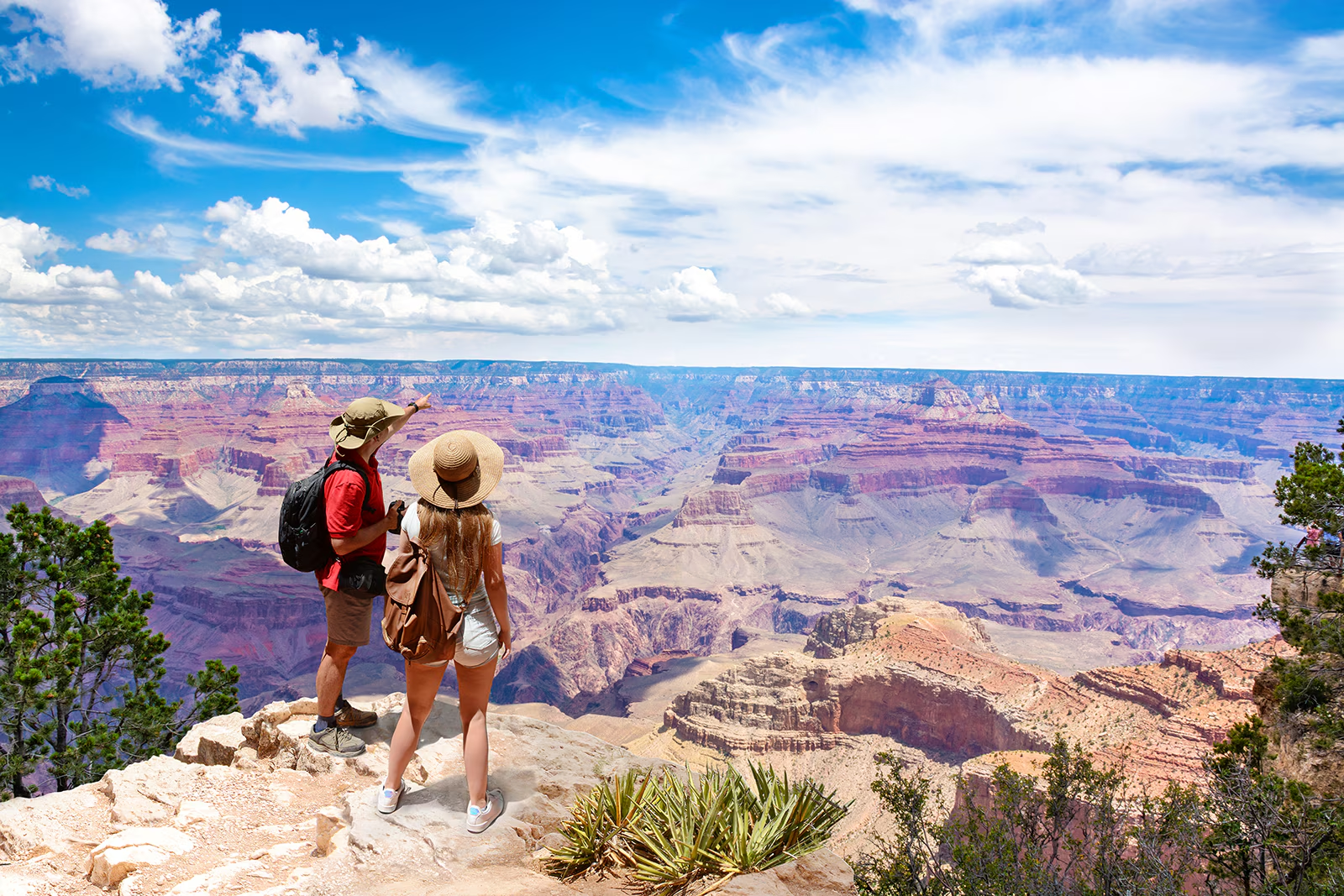
The classification of the “best nature photography spots in the United States” is frequently distorted by algorithms that amplify repetitive, high-saturation imagery. This phenomenon creates a “feedback loop of familiarity,” where the perceived value of a location is tied to its prevalence in digital feeds rather than its ecological complexity. Consequently, many photographers default to high-friction, crowded sites, overlooking the nuanced opportunities presented by less-documented wilderness areas.
A critical misunderstanding lies in the assumption that a “best” spot is an objective reality rather than a situational alignment of light, behavior, and seasonal movement. A location might be optimal for wildlife during a narrow window of migration but functionally inert for the remainder of the year. Furthermore, the search for “best” often ignores the ethical consequences of revealing precise locations. Disseminating specific coordinates for rare or sensitive subjects can incite unmanaged visitation, leading to compounding ecological damage.
To refine the search for high-utility photography locations, one must move away from destination-driven models and toward condition-driven analysis. This entails studying migration cycles, geological weather patterns, and the socio-biological health of specific zones. True mastery in this field is characterized by the ability to identify locations where the photographer’s presence causes minimal disruption while maximizing the potential for authentic behavioral or landscape documentation.
Deep Contextual Background: From Documentation to Commodification
The history of nature photography in America is inextricably linked to the formation of the National Park Service. Early practitioners like Ansel Adams and William Henry Jackson provided the visual justification for large-scale federal conservation. Their work created a “national identity” of wild, pristine space. However, this same imagery also laid the groundwork for the modern era of mass tourism.
As road infrastructure expanded throughout the mid-20th century, these “pristine” landscapes became accessible to the general public. Photography, once the domain of the patient observer, transitioned into an artifact of the modern road trip. By the early 21st century, the rise of global social sharing platforms intensified this trend, turning formerly quiet vantages into high-traffic nodes. Today’s nature photographer must contend with this legacy, recognizing that they are operating within a system designed to maximize accessibility, which often stands in direct conflict with the goals of conservation-oriented documentation.
Conceptual Frameworks and Mental Models
-
The Behavioral Disturbance Index: A model for evaluating the potential impact of one’s presence on wildlife subjects. It asks: Does my proximity force a change in the animal’s feeding, breeding, or nesting behaviors?
-
The Static vs. Kinetic Model: Static landscapes (rock formations, forests) allow for slow, methodical planning, whereas kinetic subjects (wildlife, weather events) require high-readiness, reactive preparation.
-
The Scarcity vs. Accessibility Paradox: Locations that are highly accessible are rarely “unique,” while unique locations are often highly sensitive to human presence.
-
The Margin of Autonomy: The degree to which a photographer can operate independently without relying on artificial support structures (e.g., platforms, guides) that might compromise the authenticity of the experience.
Categorizing Coastal and Interior Environments
The diversity of the American landscape dictates a range of logistical and technical requirements.
| Category | Primary Subjectivity | Logistical Challenge | Ecological Sensitivity |
| High-Alpine/Peak | Geological Form | High physical exertion | Extreme/Low recovery |
| Coastal/Riparian | Fluid Dynamics | Tidal/Weather variability | Moderate |
| Arid/Desert | Light and Texture | Extreme climate/Heat | Moderate-High |
| Forest/Old Growth | Micro-Scale Detail | Low-light management | Moderate |
When deciding between these environments, consider the Ecology-to-Aesthetic Ratio. High-alpine environments often provide striking aesthetics but possess low ecological resilience; therefore, they require more rigorous, trail-bound discipline. Conversely, riparian zones often offer high biodiversity but demand sophisticated knowledge of animal behavior to avoid conflict.
Real-World Scenarios and Decision Logic
Scenario 1: The “Iconic” Location Challenge
-
Context: A highly photographed landmark (e.g., a specific mountain reflection pool).
-
Decision Path: If the site is crowded, the objective shifts from capturing a “unique” view to documenting the environment’s state or light under unusual atmospheric conditions (e.g., storm fronts) that deter the average visitor.
-
Failure Mode: Attempting to force an original perspective in an oversaturated space, which leads to obstruction of others and frustration.
Scenario 2: The Wildlife Migration Event
-
Context: A seasonal wildlife gathering (e.g., raptor migration).
-
Decision Path: Prioritize wide-angle environmental shots or distance-based behavioral studies rather than seeking “close-up” portraiture.
-
Failure Mode: Aggressive positioning that triggers flight responses in the subjects, effectively ending the observation opportunity for everyone present.
Planning, Cost, and Resource Dynamics
The resources required for professional-grade nature documentation extend far beyond the gear bag.
-
Direct Costs: Travel, permits (often overlooked), and specialized housing (for long-term stakeout).
-
Indirect Costs: The “time debt” incurred during the research phase, including deep dives into regional ecological reports.
-
Resource Range Table:
| Intensity Level | Estimated Time Investment | Primary Resource Need |
| Low (Casual) | 1-2 days | Basic logistics/Travel |
| Medium (Thematic) | 1-2 weeks | Specialized knowledge/Research |
| High (Longitudinal) | 1-3 months+ | Field equipment/Conservation network |
Risk Landscape and Failure Modes
The failure to maintain a professional distance is the most common failure mode in nature photography. This manifests as “Subject Habituation,” where wildlife becomes desensitized to human presence, potentially leading to human-wildlife conflicts. A second failure mode is “Environmental Entitlement,” where the photographer assumes that the investment in travel and gear entitles them to the shot, regardless of environmental damage (e.g., trampling sensitive alpine flora).
Governance, Maintenance, and Long-Term Adaptation
To manage long-term impact, photographers should implement a personal “Review Cycle”:
-
Pre-Shoot Audit: Assess the environmental vulnerability of the site. Are there nesting species? Is the terrain fragile?
-
Field Monitoring: During the session, track how other visitors react to your presence. Are you inadvertently drawing crowds to a sensitive area?
-
Post-Process Review: Evaluate whether the final images contribute to a meaningful narrative or if they inadvertently promote irresponsible behavior.
Measurement, Tracking, and Evaluation
-
Leading Indicators: The extent of preparatory research, the acquisition of necessary permits, and the presence of backup gear that minimizes the need to “improvise” in sensitive areas.
-
Lagging Indicators: The final quality of the output, the environmental state of the site after departure, and the accuracy of the metadata/captions provided with the work.
Common Misconceptions and Oversimplifications
-
“Wide-angle lenses are safer”: Wide-angle photography often requires closer proximity to subjects, which can be more intrusive than telephoto work.
-
“Public land means unlimited access”: Legal access does not equate to ecological permission to disrupt habitat.
-
“Golden hour is always best”: Some subjects are better captured under the diffused light of a storm or the harsh reality of mid-day, depending on the desired visual narrative.
-
“Editing can fix poor fieldwork”: Digital manipulation of wildlife scenes can mislead the public regarding animal behavior and habitat health.
Conclusion
The search for the best nature photography spots united states is ultimately a search for clarity and connection. The true “best” spots are those where the photographer demonstrates a deep, analytical respect for the ecosystem’s autonomy. By prioritizing the health of the subject over the pursuit of the “iconic” frame, practitioners move from being simple observers to informed stewards. The landscapes of the United States remain resilient only if those who seek to capture them understand the cost of their curiosity.